
Want to Start Your Own Fashion Line But Scared Of Making Costly Mistakes?
There are three vital steps you can take right now to easily turn your creative concept into a viable, profitable business.
Today, I’ll hand you the blueprint. In April, Joanne decided to turn her design ideas into a reality.
She came into my program with a handful of sketches and a creative spark – that’s it.
Then, in November, she posted this:

In that short amount of time, she had:
- Gotten a business license
- Turned her sketches into professionally drafted patterns
- Sourced the perfect wholesale fabric
- Established a blog for content
- Had her first set of samples made
In just seven months, Joanne went from having some drawings and a dream, to being only two months away from launching her own clothing line.
This is not something that new designers are usually able to do. For most, launching your own sewn-product business (with NO prior experience) typically involves a lot of costly fumbling, failure, and frustration – take it from me. I’ve been there.
But Joanne was able to sidestep all of that, and get her business wheels in motion without the painful guesswork.
So how did she do it? My New Designer Program gave Joanne the step-by-step blueprint to launching her own line.
And today, I’m going to hand you that same roadmap.
We’ll go over the three non-negotiable steps that you MUST take if you’re looking to start your fashion business.
But First, Some Quick Housekeeping
Click here to get the our best selling A-Z Blueprint to a profitable clothing line.
Final Thoughts
I want to highlight one final detail from Joanne’s post:

Mistakes (and the fear of making them) all too often have people throwing in the towel before their dream even has a chance of getting off the ground.
And it’s a damn shame.
Joanne’s clothing line is an absolute gem. Women love it and it improves their lives! I don’t even want to think about what a waste of an idea it would have been if she had given up at the first hurdle.
Thankfully for us (and her amazing customers!), that’s not how Joanne’s story went.
But I don’t want it to be your story; I don’t want mistakes to hold you back.
Because I have no doubt in my mind that, like Joanne, you have an awesome idea that deserves to be brought into reality.
So I’m going to leave you with one final, kind of sappy sentiment:
One of my favorite parts about working with new designers is when they tell me that they’re quitting their day job because their fashion business is supporting them.
It’s happened with more students than I can even count, and it STILL gives me goosebumps.
Every. Single. Time.
And it can be your reality, too. I truly believe that.
If you’re ready, you can click here to join my New Designer Program. I’d love to have you.
Get My FREE Fabric Sourcing Guide!

In this easy-to-follow guide, I’ll give you the lowdown on the basics of wholesale fabric sourcing, as well as my own personal list of 24 wholesale fabric vendors who actually WANT to sell smaller quantities to design startups.
Click the button to download the guide
- Instant Access To The Startup Vault.
My secret stash of links and resources that I wish I had when I first started out.
You’ll also get a list of my top recommended tools and apps for design newbies, as well as freelancers for outsourcing
- Instant Access To The Startup Vault.
Click here to get the our best selling A-Z Blueprint to a profitable clothing line.
Final Thoughts
I want to highlight one final detail from Joanne’s post:
Mistakes (and the fear of making them) all too often have people throwing in the towel before their dream even has a chance of getting off the ground.
And it’s a damn shame.
Joanne’s clothing line is an absolute gem. Women love it and it improves their lives! I don’t even want to think about what a waste of an idea it would have been if she had given up at the first hurdle.
Thankfully for us (and her amazing customers!), that’s not how Joanne’s story went.
But I don’t want it to be your story; I don’t want mistakes to hold you back.
Because I have no doubt in my mind that, like Joanne, you have an awesome idea that deserves to be brought into reality.
So I’m going to leave you with one final, kind of sappy sentiment:
One of my favorite parts about working with new designers is when they tell me that they’re quitting their day job because their fashion business is supporting them.
It’s happened with more students than I can even count, and it STILL gives me goosebumps.
Every. Single. Time.
And it can be your reality, too. I truly believe that.
If you’re ready, you can click here to join my New Designer Program. I’d love to have you.
Get My FREE Fabric Sourcing Guide!
In this easy-to-follow guide, I’ll give you the lowdown on the basics of wholesale fabric sourcing, as well as my own personal list of 24 wholesale fabric vendors who actually WANT to sell smaller quantities to design startups.
Click the button to download the guide
- Access To Coaching/Q&A Video Replays.
I’ve enlisted the help of 7 top industry experts to create coaching content and answer all your burning questions.
From brand consultants to pattern makers, you’ll get some absolute golden nuggets of knowledge, straight from world-class fashion brains.
- Access To Coaching/Q&A Video Replays.
- Instant Access To The Startup Vault.
My secret stash of links and resources that I wish I had when I first started out.
You’ll also get a list of my top recommended tools and apps for design newbies, as well as freelancers for outsourcing
- Instant Access To The Startup Vault.
Click here to get the our best selling A-Z Blueprint to a profitable clothing line.
Final Thoughts
I want to highlight one final detail from Joanne’s post:
Mistakes (and the fear of making them) all too often have people throwing in the towel before their dream even has a chance of getting off the ground.
And it’s a damn shame.
Joanne’s clothing line is an absolute gem. Women love it and it improves their lives! I don’t even want to think about what a waste of an idea it would have been if she had given up at the first hurdle.
Thankfully for us (and her amazing customers!), that’s not how Joanne’s story went.
But I don’t want it to be your story; I don’t want mistakes to hold you back.
Because I have no doubt in my mind that, like Joanne, you have an awesome idea that deserves to be brought into reality.
So I’m going to leave you with one final, kind of sappy sentiment:
One of my favorite parts about working with new designers is when they tell me that they’re quitting their day job because their fashion business is supporting them.
It’s happened with more students than I can even count, and it STILL gives me goosebumps.
Every. Single. Time.
And it can be your reality, too. I truly believe that.
If you’re ready, you can click here to join my New Designer Program. I’d love to have you.
Get My FREE Fabric Sourcing Guide!
In this easy-to-follow guide, I’ll give you the lowdown on the basics of wholesale fabric sourcing, as well as my own personal list of 24 wholesale fabric vendors who actually WANT to sell smaller quantities to design startups.
Click the button to download the guide
- Instant Lifetime Access To The Entire Curriculum.
Over 25+ hours of educational content, available instantly.
We’ll cover everything from money and suppliers, to producing samples and selling, all organized into 8 jam-packed modules.
- Instant Lifetime Access To The Entire Curriculum.
- Access To Coaching/Q&A Video Replays.
I’ve enlisted the help of 7 top industry experts to create coaching content and answer all your burning questions.
From brand consultants to pattern makers, you’ll get some absolute golden nuggets of knowledge, straight from world-class fashion brains.
- Access To Coaching/Q&A Video Replays.
- Instant Access To The Startup Vault.
My secret stash of links and resources that I wish I had when I first started out.
You’ll also get a list of my top recommended tools and apps for design newbies, as well as freelancers for outsourcing
- Instant Access To The Startup Vault.
Click here to get the our best selling A-Z Blueprint to a profitable clothing line.
Final Thoughts
I want to highlight one final detail from Joanne’s post:
Mistakes (and the fear of making them) all too often have people throwing in the towel before their dream even has a chance of getting off the ground.
And it’s a damn shame.
Joanne’s clothing line is an absolute gem. Women love it and it improves their lives! I don’t even want to think about what a waste of an idea it would have been if she had given up at the first hurdle.
Thankfully for us (and her amazing customers!), that’s not how Joanne’s story went.
But I don’t want it to be your story; I don’t want mistakes to hold you back.
Because I have no doubt in my mind that, like Joanne, you have an awesome idea that deserves to be brought into reality.
So I’m going to leave you with one final, kind of sappy sentiment:
One of my favorite parts about working with new designers is when they tell me that they’re quitting their day job because their fashion business is supporting them.
It’s happened with more students than I can even count, and it STILL gives me goosebumps.
Every. Single. Time.
And it can be your reality, too. I truly believe that.
If you’re ready, you can click here to join my New Designer Program. I’d love to have you.
Get My FREE Fabric Sourcing Guide!
In this easy-to-follow guide, I’ll give you the lowdown on the basics of wholesale fabric sourcing, as well as my own personal list of 24 wholesale fabric vendors who actually WANT to sell smaller quantities to design startups.
Click the button to download the guide
- What message do you want to send to your customers?
Think about what matters to you, and be loud about it.
- What message do you want to send to your customers?
Competition
Finally, you should get to know your competition.
Not only will this help you beat them, but it allows you to get to know your own products better.
So, who is doing what you want to do, and how are they doing it?
Be honest here – no idea is 100% original, and that’s okay.
Researching what’s already out there will show you how you can bump that originality meter up! Each business is unique and yours will not be like theirs! Know the playing field before you start.
Which leads into the next question – what can you do differently to make customers choose you?
This answer might not come to you right away; it will likely reveal itself over time. Let it marinate.
Step Three: Build Your Audience

Wait…what? You want me to build an audience before my product is ready for sale?
Yep.
This is something that NOT a lot of mentors in the fashion space teach their students.
And for the life of me, I can’t figure out why.
Because when you develop your product and your audience simultaneously, you have customers ready to buy as soon as your products are available.
Take movies, for example:
They get promoted looong before they’re anywhere near finished – I’m talking multiple months, if not years.
And it’s extremely effective. This is how they get people lined up outside the movie theaters on release day.
There are two steps you can take to replicate this blockbuster-esque rollout (and demand) for your own business:
Capture Emails
One of my favorite stats is this: according to HubSpot, email marketing generates $38 for every $1 spent.
EMAIL IS POWERFUL! Do not underestimate it.
One of the biggest sales leaps you can take for your business is to start building a pre-launch list, as early as possible.
Initially, I want you to think of it like a holiday card list – create a spreadsheet of everyone in your life that you want to simply tell about your launch.
Your friends, family, colleagues – include anyone and everyone you can think of.
Now obviously, not all of these people are going to be future customers (though some of them might be).
The main goal here is to just get the wheels moving, and add some names on that list. Your people know other people and some of them are ideal buyers for you.
To build this point, you’ll want to include some kind of opt-in on a blog or website – which brings us to our next step:
Establish A Simple Blog
I use the word ‘blog’ pretty loosely here.
Depending on your personal preference (and what your ideal customer would be into), it could look like a traditional written blog.
But it could also be short videos, long-form videos, podcast episodes – whatever the heck you want! It’s a hub for content on your website.
One practical piece of advice, though: don’t rely on social media.
Your blog will serve as a home base for your business. Ideally, you want to own that home.
So think of social media as a supplementary tool, and not your main gathering space.
When it comes to the content on your blog, you could:
- Write articles
- Do Q&As or tips relating to your niche
- Keep a photo diary
- Document your creative process/behind the scenes content
Whatever you choose, the single biggest thing to keep in mind is that you want to add value to your audience’s life in some way – no matter how small that may be.
Because the aim of this step is to NOT build an audience around your product.
It’s to build a community of like-minded people.
Ultimately, this community would want to buy what you eventually produce – but their existence in your circle is not solely dependent on a product.
The only way you’re going to rally that community around you is by making your existence in their life worthwhile.
Ready To Make Your Design Dreams A Reality – Without Making Any Costly Business Blunders?
My single biggest goal right now is to make sure that anyone who wants to launch their own line can focus on what truly matters to them – their product.
Without their business floundering.
And those three steps are the perfect starting point for you to do exactly that.
But I think we can take it up a notch or two…or ten. 😃
If you’re ready to soak up all the business knowledge you need to simply and successfully launch your own profitable line, the New Designer Program will get you there.
New Designer Program: The Blueprint For Launching A Successful Clothing Line
The New Designer Program is an online go-at-your-own-pace course that will take you from sketching to selling.
Here’s what you get when you join:
- Instant Lifetime Access To The Entire Curriculum.
Over 25+ hours of educational content, available instantly.
We’ll cover everything from money and suppliers, to producing samples and selling, all organized into 8 jam-packed modules.
- Instant Lifetime Access To The Entire Curriculum.
- Access To Coaching/Q&A Video Replays.
I’ve enlisted the help of 7 top industry experts to create coaching content and answer all your burning questions.
From brand consultants to pattern makers, you’ll get some absolute golden nuggets of knowledge, straight from world-class fashion brains.
- Access To Coaching/Q&A Video Replays.
- Instant Access To The Startup Vault.
My secret stash of links and resources that I wish I had when I first started out.
You’ll also get a list of my top recommended tools and apps for design newbies, as well as freelancers for outsourcing
- Instant Access To The Startup Vault.
Click here to get the our best selling A-Z Blueprint to a profitable clothing line.
Final Thoughts
I want to highlight one final detail from Joanne’s post:
Mistakes (and the fear of making them) all too often have people throwing in the towel before their dream even has a chance of getting off the ground.
And it’s a damn shame.
Joanne’s clothing line is an absolute gem. Women love it and it improves their lives! I don’t even want to think about what a waste of an idea it would have been if she had given up at the first hurdle.
Thankfully for us (and her amazing customers!), that’s not how Joanne’s story went.
But I don’t want it to be your story; I don’t want mistakes to hold you back.
Because I have no doubt in my mind that, like Joanne, you have an awesome idea that deserves to be brought into reality.
So I’m going to leave you with one final, kind of sappy sentiment:
One of my favorite parts about working with new designers is when they tell me that they’re quitting their day job because their fashion business is supporting them.
It’s happened with more students than I can even count, and it STILL gives me goosebumps.
Every. Single. Time.
And it can be your reality, too. I truly believe that.
If you’re ready, you can click here to join my New Designer Program. I’d love to have you.
Get My FREE Fabric Sourcing Guide!
In this easy-to-follow guide, I’ll give you the lowdown on the basics of wholesale fabric sourcing, as well as my own personal list of 24 wholesale fabric vendors who actually WANT to sell smaller quantities to design startups.
Click the button to download the guide
- How your business is viewed by the world
This is a combination of your core values, and how your products serve your customers.
- How your business is viewed by the world
- What values do you want to amplify through your business?
- What message do you want to send to your customers?
Think about what matters to you, and be loud about it.
- What message do you want to send to your customers?
Competition
Finally, you should get to know your competition.
Not only will this help you beat them, but it allows you to get to know your own products better.
So, who is doing what you want to do, and how are they doing it?
Be honest here – no idea is 100% original, and that’s okay.
Researching what’s already out there will show you how you can bump that originality meter up! Each business is unique and yours will not be like theirs! Know the playing field before you start.
Which leads into the next question – what can you do differently to make customers choose you?
This answer might not come to you right away; it will likely reveal itself over time. Let it marinate.
Step Three: Build Your Audience
Wait…what? You want me to build an audience before my product is ready for sale?
Yep.
This is something that NOT a lot of mentors in the fashion space teach their students.
And for the life of me, I can’t figure out why.
Because when you develop your product and your audience simultaneously, you have customers ready to buy as soon as your products are available.
Take movies, for example:
They get promoted looong before they’re anywhere near finished – I’m talking multiple months, if not years.
And it’s extremely effective. This is how they get people lined up outside the movie theaters on release day.
There are two steps you can take to replicate this blockbuster-esque rollout (and demand) for your own business:
Capture Emails
One of my favorite stats is this: according to HubSpot, email marketing generates $38 for every $1 spent.
EMAIL IS POWERFUL! Do not underestimate it.
One of the biggest sales leaps you can take for your business is to start building a pre-launch list, as early as possible.
Initially, I want you to think of it like a holiday card list – create a spreadsheet of everyone in your life that you want to simply tell about your launch.
Your friends, family, colleagues – include anyone and everyone you can think of.
Now obviously, not all of these people are going to be future customers (though some of them might be).
The main goal here is to just get the wheels moving, and add some names on that list. Your people know other people and some of them are ideal buyers for you.
To build this point, you’ll want to include some kind of opt-in on a blog or website – which brings us to our next step:
Establish A Simple Blog
I use the word ‘blog’ pretty loosely here.
Depending on your personal preference (and what your ideal customer would be into), it could look like a traditional written blog.
But it could also be short videos, long-form videos, podcast episodes – whatever the heck you want! It’s a hub for content on your website.
One practical piece of advice, though: don’t rely on social media.
Your blog will serve as a home base for your business. Ideally, you want to own that home.
So think of social media as a supplementary tool, and not your main gathering space.
When it comes to the content on your blog, you could:
- Write articles
- Do Q&As or tips relating to your niche
- Keep a photo diary
- Document your creative process/behind the scenes content
Whatever you choose, the single biggest thing to keep in mind is that you want to add value to your audience’s life in some way – no matter how small that may be.
Because the aim of this step is to NOT build an audience around your product.
It’s to build a community of like-minded people.
Ultimately, this community would want to buy what you eventually produce – but their existence in your circle is not solely dependent on a product.
The only way you’re going to rally that community around you is by making your existence in their life worthwhile.
Ready To Make Your Design Dreams A Reality – Without Making Any Costly Business Blunders?
My single biggest goal right now is to make sure that anyone who wants to launch their own line can focus on what truly matters to them – their product.
Without their business floundering.
And those three steps are the perfect starting point for you to do exactly that.
But I think we can take it up a notch or two…or ten. 😃
If you’re ready to soak up all the business knowledge you need to simply and successfully launch your own profitable line, the New Designer Program will get you there.
New Designer Program: The Blueprint For Launching A Successful Clothing Line
The New Designer Program is an online go-at-your-own-pace course that will take you from sketching to selling.
Here’s what you get when you join:
- Instant Lifetime Access To The Entire Curriculum.
Over 25+ hours of educational content, available instantly.
We’ll cover everything from money and suppliers, to producing samples and selling, all organized into 8 jam-packed modules.
- Instant Lifetime Access To The Entire Curriculum.
- Access To Coaching/Q&A Video Replays.
I’ve enlisted the help of 7 top industry experts to create coaching content and answer all your burning questions.
From brand consultants to pattern makers, you’ll get some absolute golden nuggets of knowledge, straight from world-class fashion brains.
- Access To Coaching/Q&A Video Replays.
- Instant Access To The Startup Vault.
My secret stash of links and resources that I wish I had when I first started out.
You’ll also get a list of my top recommended tools and apps for design newbies, as well as freelancers for outsourcing
- Instant Access To The Startup Vault.
Click here to get the our best selling A-Z Blueprint to a profitable clothing line.
Final Thoughts
I want to highlight one final detail from Joanne’s post:
Mistakes (and the fear of making them) all too often have people throwing in the towel before their dream even has a chance of getting off the ground.
And it’s a damn shame.
Joanne’s clothing line is an absolute gem. Women love it and it improves their lives! I don’t even want to think about what a waste of an idea it would have been if she had given up at the first hurdle.
Thankfully for us (and her amazing customers!), that’s not how Joanne’s story went.
But I don’t want it to be your story; I don’t want mistakes to hold you back.
Because I have no doubt in my mind that, like Joanne, you have an awesome idea that deserves to be brought into reality.
So I’m going to leave you with one final, kind of sappy sentiment:
One of my favorite parts about working with new designers is when they tell me that they’re quitting their day job because their fashion business is supporting them.
It’s happened with more students than I can even count, and it STILL gives me goosebumps.
Every. Single. Time.
And it can be your reality, too. I truly believe that.
If you’re ready, you can click here to join my New Designer Program. I’d love to have you.
Get My FREE Fabric Sourcing Guide!
In this easy-to-follow guide, I’ll give you the lowdown on the basics of wholesale fabric sourcing, as well as my own personal list of 24 wholesale fabric vendors who actually WANT to sell smaller quantities to design startups.
Click the button to download the guide
- How will you prioritize their wellbeing?
But it’s not just about your employees – you need to enjoy your work too!
So remember to also think about what kind of company culture you want to be a part of; what does your ideal work environment look like?
One of my students started her own business just so she could bring her dog into work with her (now THAT’S some dedicated fur parenting).
- How will you prioritize their wellbeing?
I really want you to get creative with this – those small, day-to-day details can truly make or break your morale and how much you want to go to work in the morning..
- How your business is viewed by the world
This is a combination of your core values, and how your products serve your customers.
- How your business is viewed by the world
- What values do you want to amplify through your business?
- What message do you want to send to your customers?
Think about what matters to you, and be loud about it.
- What message do you want to send to your customers?
Competition
Finally, you should get to know your competition.
Not only will this help you beat them, but it allows you to get to know your own products better.
So, who is doing what you want to do, and how are they doing it?
Be honest here – no idea is 100% original, and that’s okay.
Researching what’s already out there will show you how you can bump that originality meter up! Each business is unique and yours will not be like theirs! Know the playing field before you start.
Which leads into the next question – what can you do differently to make customers choose you?
This answer might not come to you right away; it will likely reveal itself over time. Let it marinate.
Step Three: Build Your Audience
Wait…what? You want me to build an audience before my product is ready for sale?
Yep.
This is something that NOT a lot of mentors in the fashion space teach their students.
And for the life of me, I can’t figure out why.
Because when you develop your product and your audience simultaneously, you have customers ready to buy as soon as your products are available.
Take movies, for example:
They get promoted looong before they’re anywhere near finished – I’m talking multiple months, if not years.
And it’s extremely effective. This is how they get people lined up outside the movie theaters on release day.
There are two steps you can take to replicate this blockbuster-esque rollout (and demand) for your own business:
Capture Emails
One of my favorite stats is this: according to HubSpot, email marketing generates $38 for every $1 spent.
EMAIL IS POWERFUL! Do not underestimate it.
One of the biggest sales leaps you can take for your business is to start building a pre-launch list, as early as possible.
Initially, I want you to think of it like a holiday card list – create a spreadsheet of everyone in your life that you want to simply tell about your launch.
Your friends, family, colleagues – include anyone and everyone you can think of.
Now obviously, not all of these people are going to be future customers (though some of them might be).
The main goal here is to just get the wheels moving, and add some names on that list. Your people know other people and some of them are ideal buyers for you.
To build this point, you’ll want to include some kind of opt-in on a blog or website – which brings us to our next step:
Establish A Simple Blog
I use the word ‘blog’ pretty loosely here.
Depending on your personal preference (and what your ideal customer would be into), it could look like a traditional written blog.
But it could also be short videos, long-form videos, podcast episodes – whatever the heck you want! It’s a hub for content on your website.
One practical piece of advice, though: don’t rely on social media.
Your blog will serve as a home base for your business. Ideally, you want to own that home.
So think of social media as a supplementary tool, and not your main gathering space.
When it comes to the content on your blog, you could:
- Write articles
- Do Q&As or tips relating to your niche
- Keep a photo diary
- Document your creative process/behind the scenes content
Whatever you choose, the single biggest thing to keep in mind is that you want to add value to your audience’s life in some way – no matter how small that may be.
Because the aim of this step is to NOT build an audience around your product.
It’s to build a community of like-minded people.
Ultimately, this community would want to buy what you eventually produce – but their existence in your circle is not solely dependent on a product.
The only way you’re going to rally that community around you is by making your existence in their life worthwhile.
Ready To Make Your Design Dreams A Reality – Without Making Any Costly Business Blunders?
My single biggest goal right now is to make sure that anyone who wants to launch their own line can focus on what truly matters to them – their product.
Without their business floundering.
And those three steps are the perfect starting point for you to do exactly that.
But I think we can take it up a notch or two…or ten. 😃
If you’re ready to soak up all the business knowledge you need to simply and successfully launch your own profitable line, the New Designer Program will get you there.
New Designer Program: The Blueprint For Launching A Successful Clothing Line
The New Designer Program is an online go-at-your-own-pace course that will take you from sketching to selling.
Here’s what you get when you join:
- Instant Lifetime Access To The Entire Curriculum.
Over 25+ hours of educational content, available instantly.
We’ll cover everything from money and suppliers, to producing samples and selling, all organized into 8 jam-packed modules.
- Instant Lifetime Access To The Entire Curriculum.
- Access To Coaching/Q&A Video Replays.
I’ve enlisted the help of 7 top industry experts to create coaching content and answer all your burning questions.
From brand consultants to pattern makers, you’ll get some absolute golden nuggets of knowledge, straight from world-class fashion brains.
- Access To Coaching/Q&A Video Replays.
- Instant Access To The Startup Vault.
My secret stash of links and resources that I wish I had when I first started out.
You’ll also get a list of my top recommended tools and apps for design newbies, as well as freelancers for outsourcing
- Instant Access To The Startup Vault.
Click here to get the our best selling A-Z Blueprint to a profitable clothing line.
Final Thoughts
I want to highlight one final detail from Joanne’s post:
Mistakes (and the fear of making them) all too often have people throwing in the towel before their dream even has a chance of getting off the ground.
And it’s a damn shame.
Joanne’s clothing line is an absolute gem. Women love it and it improves their lives! I don’t even want to think about what a waste of an idea it would have been if she had given up at the first hurdle.
Thankfully for us (and her amazing customers!), that’s not how Joanne’s story went.
But I don’t want it to be your story; I don’t want mistakes to hold you back.
Because I have no doubt in my mind that, like Joanne, you have an awesome idea that deserves to be brought into reality.
So I’m going to leave you with one final, kind of sappy sentiment:
One of my favorite parts about working with new designers is when they tell me that they’re quitting their day job because their fashion business is supporting them.
It’s happened with more students than I can even count, and it STILL gives me goosebumps.
Every. Single. Time.
And it can be your reality, too. I truly believe that.
If you’re ready, you can click here to join my New Designer Program. I’d love to have you.
Get My FREE Fabric Sourcing Guide!
In this easy-to-follow guide, I’ll give you the lowdown on the basics of wholesale fabric sourcing, as well as my own personal list of 24 wholesale fabric vendors who actually WANT to sell smaller quantities to design startups.
Click the button to download the guide
- What it’s like to work in your business
In the beginning, everything in your business may be handled solely by you.
But eventually, you’re going to need to enlist some help.
It’s well worth considering what you want that experience to be like for your future employees:
- What it’s like to work in your business
- What do you want their day-to-day experience to be like?
- How will you prioritize their wellbeing?
But it’s not just about your employees – you need to enjoy your work too!
So remember to also think about what kind of company culture you want to be a part of; what does your ideal work environment look like?
One of my students started her own business just so she could bring her dog into work with her (now THAT’S some dedicated fur parenting).
- How will you prioritize their wellbeing?
I really want you to get creative with this – those small, day-to-day details can truly make or break your morale and how much you want to go to work in the morning..
- How your business is viewed by the world
This is a combination of your core values, and how your products serve your customers.
- How your business is viewed by the world
- What values do you want to amplify through your business?
- What message do you want to send to your customers?
Think about what matters to you, and be loud about it.
- What message do you want to send to your customers?
Competition
Finally, you should get to know your competition.
Not only will this help you beat them, but it allows you to get to know your own products better.
So, who is doing what you want to do, and how are they doing it?
Be honest here – no idea is 100% original, and that’s okay.
Researching what’s already out there will show you how you can bump that originality meter up! Each business is unique and yours will not be like theirs! Know the playing field before you start.
Which leads into the next question – what can you do differently to make customers choose you?
This answer might not come to you right away; it will likely reveal itself over time. Let it marinate.
Step Three: Build Your Audience
Wait…what? You want me to build an audience before my product is ready for sale?
Yep.
This is something that NOT a lot of mentors in the fashion space teach their students.
And for the life of me, I can’t figure out why.
Because when you develop your product and your audience simultaneously, you have customers ready to buy as soon as your products are available.
Take movies, for example:
They get promoted looong before they’re anywhere near finished – I’m talking multiple months, if not years.
And it’s extremely effective. This is how they get people lined up outside the movie theaters on release day.
There are two steps you can take to replicate this blockbuster-esque rollout (and demand) for your own business:
Capture Emails
One of my favorite stats is this: according to HubSpot, email marketing generates $38 for every $1 spent.
EMAIL IS POWERFUL! Do not underestimate it.
One of the biggest sales leaps you can take for your business is to start building a pre-launch list, as early as possible.
Initially, I want you to think of it like a holiday card list – create a spreadsheet of everyone in your life that you want to simply tell about your launch.
Your friends, family, colleagues – include anyone and everyone you can think of.
Now obviously, not all of these people are going to be future customers (though some of them might be).
The main goal here is to just get the wheels moving, and add some names on that list. Your people know other people and some of them are ideal buyers for you.
To build this point, you’ll want to include some kind of opt-in on a blog or website – which brings us to our next step:
Establish A Simple Blog
I use the word ‘blog’ pretty loosely here.
Depending on your personal preference (and what your ideal customer would be into), it could look like a traditional written blog.
But it could also be short videos, long-form videos, podcast episodes – whatever the heck you want! It’s a hub for content on your website.
One practical piece of advice, though: don’t rely on social media.
Your blog will serve as a home base for your business. Ideally, you want to own that home.
So think of social media as a supplementary tool, and not your main gathering space.
When it comes to the content on your blog, you could:
- Write articles
- Do Q&As or tips relating to your niche
- Keep a photo diary
- Document your creative process/behind the scenes content
Whatever you choose, the single biggest thing to keep in mind is that you want to add value to your audience’s life in some way – no matter how small that may be.
Because the aim of this step is to NOT build an audience around your product.
It’s to build a community of like-minded people.
Ultimately, this community would want to buy what you eventually produce – but their existence in your circle is not solely dependent on a product.
The only way you’re going to rally that community around you is by making your existence in their life worthwhile.
Ready To Make Your Design Dreams A Reality – Without Making Any Costly Business Blunders?
My single biggest goal right now is to make sure that anyone who wants to launch their own line can focus on what truly matters to them – their product.
Without their business floundering.
And those three steps are the perfect starting point for you to do exactly that.
But I think we can take it up a notch or two…or ten. 😃
If you’re ready to soak up all the business knowledge you need to simply and successfully launch your own profitable line, the New Designer Program will get you there.
New Designer Program: The Blueprint For Launching A Successful Clothing Line
The New Designer Program is an online go-at-your-own-pace course that will take you from sketching to selling.
Here’s what you get when you join:
- Instant Lifetime Access To The Entire Curriculum.
Over 25+ hours of educational content, available instantly.
We’ll cover everything from money and suppliers, to producing samples and selling, all organized into 8 jam-packed modules.
- Instant Lifetime Access To The Entire Curriculum.
- Access To Coaching/Q&A Video Replays.
I’ve enlisted the help of 7 top industry experts to create coaching content and answer all your burning questions.
From brand consultants to pattern makers, you’ll get some absolute golden nuggets of knowledge, straight from world-class fashion brains.
- Access To Coaching/Q&A Video Replays.
- Instant Access To The Startup Vault.
My secret stash of links and resources that I wish I had when I first started out.
You’ll also get a list of my top recommended tools and apps for design newbies, as well as freelancers for outsourcing
- Instant Access To The Startup Vault.
Click here to get the our best selling A-Z Blueprint to a profitable clothing line.
Final Thoughts
I want to highlight one final detail from Joanne’s post:
Mistakes (and the fear of making them) all too often have people throwing in the towel before their dream even has a chance of getting off the ground.
And it’s a damn shame.
Joanne’s clothing line is an absolute gem. Women love it and it improves their lives! I don’t even want to think about what a waste of an idea it would have been if she had given up at the first hurdle.
Thankfully for us (and her amazing customers!), that’s not how Joanne’s story went.
But I don’t want it to be your story; I don’t want mistakes to hold you back.
Because I have no doubt in my mind that, like Joanne, you have an awesome idea that deserves to be brought into reality.
So I’m going to leave you with one final, kind of sappy sentiment:
One of my favorite parts about working with new designers is when they tell me that they’re quitting their day job because their fashion business is supporting them.
It’s happened with more students than I can even count, and it STILL gives me goosebumps.
Every. Single. Time.
And it can be your reality, too. I truly believe that.
If you’re ready, you can click here to join my New Designer Program. I’d love to have you.
Get My FREE Fabric Sourcing Guide!
In this easy-to-follow guide, I’ll give you the lowdown on the basics of wholesale fabric sourcing, as well as my own personal list of 24 wholesale fabric vendors who actually WANT to sell smaller quantities to design startups.
Click the button to download the guide
- Competition
- Competition
All four areas MUST be in alignment for a business to be successful: That is, your creative concept and company culture needs to appeal to your perfect customer, and you need to know your competition to set yourself apart.
Concept
To get clear on your creative concept, answer a few basic questions:
- What is your creative idea and what excites you about it?
- When someone uses your product, how will it enrich their life?
- How will your product truly be different from what’s already out there? (this is your 1 BIG THING – and it’s super important)
In any industry, it’s way too easy to get swept away in chasing trends to make money.
Having these answers written down will keep you grounded in your mission, and focused on what truly matters to you.
Customer
Next, narrow down your ideal customer – who do you want to see wearing/using your product?
The most common answer to this (it was mine when I first started) is “anyone with money”.
Which sounds great in theory, but a market consisting of literally everyone is just too broad to be effective.
Selling anything requires a focused vision of the exact person you’re trying to reach.
That laser-focus makes everything easier (really, everything) – from marketing, to designing, to choosing sales avenues.
Here’s my personal checklist of what makes an ideal customer:

Culture
Company culture is two-fold:
- What it’s like to work in your business
In the beginning, everything in your business may be handled solely by you.
But eventually, you’re going to need to enlist some help.
It’s well worth considering what you want that experience to be like for your future employees:
- What it’s like to work in your business
- What do you want their day-to-day experience to be like?
- How will you prioritize their wellbeing?
But it’s not just about your employees – you need to enjoy your work too!
So remember to also think about what kind of company culture you want to be a part of; what does your ideal work environment look like?
One of my students started her own business just so she could bring her dog into work with her (now THAT’S some dedicated fur parenting).
- How will you prioritize their wellbeing?
I really want you to get creative with this – those small, day-to-day details can truly make or break your morale and how much you want to go to work in the morning..
- How your business is viewed by the world
This is a combination of your core values, and how your products serve your customers.
- How your business is viewed by the world
- What values do you want to amplify through your business?
- What message do you want to send to your customers?
Think about what matters to you, and be loud about it.
- What message do you want to send to your customers?
Competition
Finally, you should get to know your competition.
Not only will this help you beat them, but it allows you to get to know your own products better.
So, who is doing what you want to do, and how are they doing it?
Be honest here – no idea is 100% original, and that’s okay.
Researching what’s already out there will show you how you can bump that originality meter up! Each business is unique and yours will not be like theirs! Know the playing field before you start.
Which leads into the next question – what can you do differently to make customers choose you?
This answer might not come to you right away; it will likely reveal itself over time. Let it marinate.
Step Three: Build Your Audience
Wait…what? You want me to build an audience before my product is ready for sale?
Yep.
This is something that NOT a lot of mentors in the fashion space teach their students.
And for the life of me, I can’t figure out why.
Because when you develop your product and your audience simultaneously, you have customers ready to buy as soon as your products are available.
Take movies, for example:
They get promoted looong before they’re anywhere near finished – I’m talking multiple months, if not years.
And it’s extremely effective. This is how they get people lined up outside the movie theaters on release day.
There are two steps you can take to replicate this blockbuster-esque rollout (and demand) for your own business:
Capture Emails
One of my favorite stats is this: according to HubSpot, email marketing generates $38 for every $1 spent.
EMAIL IS POWERFUL! Do not underestimate it.
One of the biggest sales leaps you can take for your business is to start building a pre-launch list, as early as possible.
Initially, I want you to think of it like a holiday card list – create a spreadsheet of everyone in your life that you want to simply tell about your launch.
Your friends, family, colleagues – include anyone and everyone you can think of.
Now obviously, not all of these people are going to be future customers (though some of them might be).
The main goal here is to just get the wheels moving, and add some names on that list. Your people know other people and some of them are ideal buyers for you.
To build this point, you’ll want to include some kind of opt-in on a blog or website – which brings us to our next step:
Establish A Simple Blog
I use the word ‘blog’ pretty loosely here.
Depending on your personal preference (and what your ideal customer would be into), it could look like a traditional written blog.
But it could also be short videos, long-form videos, podcast episodes – whatever the heck you want! It’s a hub for content on your website.
One practical piece of advice, though: don’t rely on social media.
Your blog will serve as a home base for your business. Ideally, you want to own that home.
So think of social media as a supplementary tool, and not your main gathering space.
When it comes to the content on your blog, you could:
- Write articles
- Do Q&As or tips relating to your niche
- Keep a photo diary
- Document your creative process/behind the scenes content
Whatever you choose, the single biggest thing to keep in mind is that you want to add value to your audience’s life in some way – no matter how small that may be.
Because the aim of this step is to NOT build an audience around your product.
It’s to build a community of like-minded people.
Ultimately, this community would want to buy what you eventually produce – but their existence in your circle is not solely dependent on a product.
The only way you’re going to rally that community around you is by making your existence in their life worthwhile.
Ready To Make Your Design Dreams A Reality – Without Making Any Costly Business Blunders?
My single biggest goal right now is to make sure that anyone who wants to launch their own line can focus on what truly matters to them – their product.
Without their business floundering.
And those three steps are the perfect starting point for you to do exactly that.
But I think we can take it up a notch or two…or ten. 😃
If you’re ready to soak up all the business knowledge you need to simply and successfully launch your own profitable line, the New Designer Program will get you there.
New Designer Program: The Blueprint For Launching A Successful Clothing Line
The New Designer Program is an online go-at-your-own-pace course that will take you from sketching to selling.
Here’s what you get when you join:
- Instant Lifetime Access To The Entire Curriculum.
Over 25+ hours of educational content, available instantly.
We’ll cover everything from money and suppliers, to producing samples and selling, all organized into 8 jam-packed modules.
- Instant Lifetime Access To The Entire Curriculum.
- Access To Coaching/Q&A Video Replays.
I’ve enlisted the help of 7 top industry experts to create coaching content and answer all your burning questions.
From brand consultants to pattern makers, you’ll get some absolute golden nuggets of knowledge, straight from world-class fashion brains.
- Access To Coaching/Q&A Video Replays.
- Instant Access To The Startup Vault.
My secret stash of links and resources that I wish I had when I first started out.
You’ll also get a list of my top recommended tools and apps for design newbies, as well as freelancers for outsourcing
- Instant Access To The Startup Vault.
Click here to get the our best selling A-Z Blueprint to a profitable clothing line.
Final Thoughts
I want to highlight one final detail from Joanne’s post:
Mistakes (and the fear of making them) all too often have people throwing in the towel before their dream even has a chance of getting off the ground.
And it’s a damn shame.
Joanne’s clothing line is an absolute gem. Women love it and it improves their lives! I don’t even want to think about what a waste of an idea it would have been if she had given up at the first hurdle.
Thankfully for us (and her amazing customers!), that’s not how Joanne’s story went.
But I don’t want it to be your story; I don’t want mistakes to hold you back.
Because I have no doubt in my mind that, like Joanne, you have an awesome idea that deserves to be brought into reality.
So I’m going to leave you with one final, kind of sappy sentiment:
One of my favorite parts about working with new designers is when they tell me that they’re quitting their day job because their fashion business is supporting them.
It’s happened with more students than I can even count, and it STILL gives me goosebumps.
Every. Single. Time.
And it can be your reality, too. I truly believe that.
If you’re ready, you can click here to join my New Designer Program. I’d love to have you.
Get My FREE Fabric Sourcing Guide!
In this easy-to-follow guide, I’ll give you the lowdown on the basics of wholesale fabric sourcing, as well as my own personal list of 24 wholesale fabric vendors who actually WANT to sell smaller quantities to design startups.
Click the button to download the guide
- Item #2: “Is the New Designer Program just for newbies?”
NO!
If you already have an established fashion business but feel a bit wobbly on your feet, what I teach also works perfectly as a means of solidifying your success.
The One Key Factor That Can Single-Handedly Tank Your Clothing Line – Before You Even Launch.
Okay, deep breath.
I’m going to tell you something that you probably already know, but really don’t want to hear:
Starting your own clothing line is tough.
It’s complicated…overwhelming…exhausting…
Any other scary adjectives you can think of, feel free to chuck them into the mix, too. I guarantee they’ll apply.
See, taking the leap to turn your creative pipedreams into a profitable reality feels like risky business.
If you’ve got a family to support and bills to pay, it can feel irresponsible.
And when you don’t know what you’re doing, it can actually be those things.
I know because I’ve done it.
When I was 25, I launched my own clothing line and ran a boutique for over 14 years. I sold wholesale to places like Bloomingdales, Saks, and Macy’s.
And I made almost every mistake you could think of – and then some.
But amongst all of that doom and gloom (sorry about that), I learnt something that I wish I’d realized sooner:
Almost every single failure or setback you could possibly experience as a designer is caused by one key factor.
That’s it.
Just one.
Every mistake that I made falls into this category. Every tanked fashion business can trace their failure back to it.
And I guarantee that if you don’t read this post today, it’ll trip you up, too.
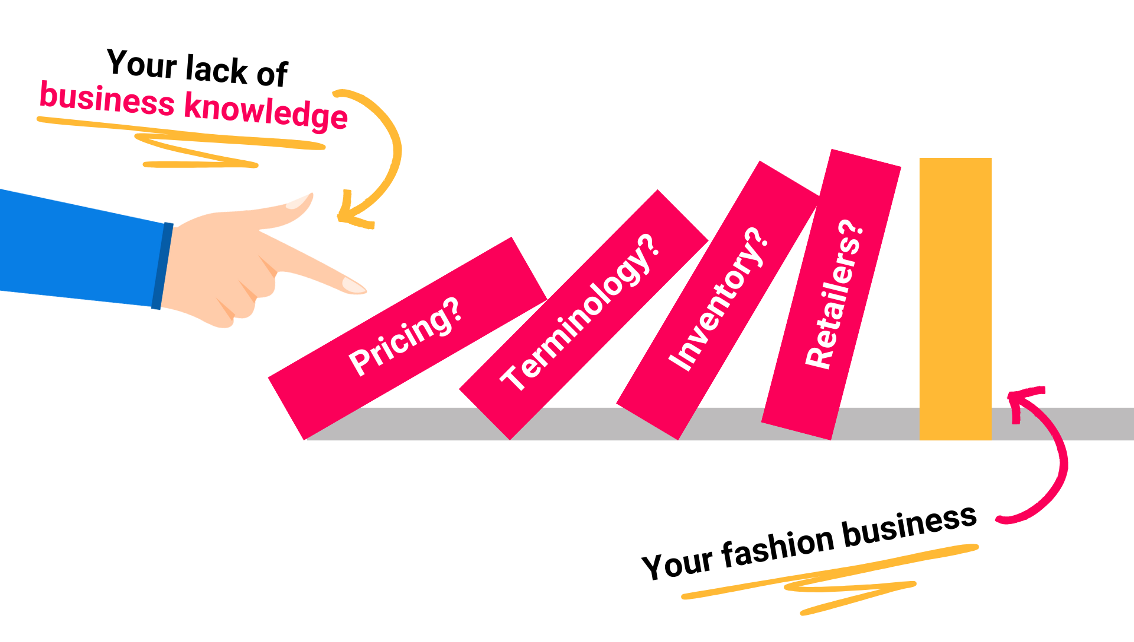
It’s a lack of business knowledge.
I do want to take a quick moment to go over exactly what that means for you and why it’s so detrimental, but a quick spoiler for the impatient reader:
It’s an error that is very easily avoided (I’ll teach you how just a bit further down the page).
A Lack Of Business Knowledge Is The Root Cause Of Almost Every Failed Fashion Venture (And Why That’s Actually A GOOD Thing)

Most aspiring designers (myself included) dive headfirst into this world without a thorough understanding of the practical, technical side of what it will take to run their business.
And I get it.
If you have an idea for a product, all you care about is bringing it to life, and getting it into the hands of those who want or need it.
But unfortunately, a killer product concept alone is simply not enough to succeed.
I sure thought it was – but once I launched, I quickly learnt that I was waaay off the mark. Looking back now, I can pretty clearly see how my lack of business knowledge created a domino effect. I had zero clue about things like:
- Margins and pricing: I almost opened my business selling at wholesale prices. I corrected this literally the day before opening.
- Terminology: Communication with manufacturers was rough – it felt like we were speaking completely different languages.
- Inventory and back stock: If a product sold out on the floor, that meant we were fresh out. Not too great when people want stuff, like, yesterday.
- Sizing: I lived in the area, I saw the women I wanted to sell to every single day, and yet…I was so off the mark on which sizes to order, and which sizes my ideal customer would actually want to buy.
- Working with big-box retailers: Not long after opening my store, Macy’s got in touch wanting to stock my line! Woohoo!
- Margins and pricing: I almost opened my business selling at wholesale prices. I corrected this literally the day before opening.
BUT… I was so out of my depth that I gave them a totally unnecessary 8% discount, and majorly cut into my potential profits. Not so woohoo. The flip side of this, though, is that once I was more business-savvy, I was able to…
- Move stock easily and predictably
- Think ahead and clearly see what my next move should be
- Read my market and figure out what works and what doesn’t (and why)
- Make smarter decisions, with confidence
- Build and maintain the stable, successful fashion business of my dreams
- Make smarter decisions, with confidence
So in a way, the fact that a lack of business acumen has such a detrimental flow-on effect is actually a good thing. Because it means that if you gain that knowledge now, you can bypass the painful, expensive learning curves that so many designers have fallen victim to.

It removes the risk, and allows you to pursue your dreams and ideas responsibly, and with confidence.
Okay Jane, that’s all well and good…
But where do I even begin to get this elusive business knowledge you speak of?
How do I figure out what I need to know, and what I don’t?
Well those are some great questions…even if I do say so myself.
Luckily for you, I’ve compiled any and every bit of fashion biz know-how that you’ll need into one neat package (aka my New Designer Program – you can click here to learn more).
But I won’t lie to you – there’s a lot to cover.
So today, we’re just gonna start with the absolute basics.
Fashion Business Fundamentals:
The 3 Essential Steps You MUST Take Before You Even Start Making Samples

The three steps I’m going to walk you through are pulled from the first three modules of the New Designer Program.
In my mind, these three steps form ground zero of design business knowledge:
- Step One: Set Your Foundations – sort out logistical stuff like legal requirements and sales avenues.
- Step Two: The Four C’s – align your concept and business culture with your customers, and beat your competition.
- Step Three: Build Your Audience – create a community that’s ready to buy as soon as you launch.
Essentially, I’m about to cover the absolute bare minimum you MUST know if you want to even have a chance of getting your business off the ground.

First things first – you need to eat the frog.
As in, you need to tackle the not-so-fun stuff first, before you can move onto what you’d probably rather be doing.
For us, our frog is all the finicky planning and logistics…stuff.
They may not feel like they’re getting us closer to our goal, but it all needs to be dealt with sooner or later.
And the earlier, the better.
Frog #1: Plan Your Timeline To Launch
Top of the list is to plan out a rough (take note!)timeline between now, and your estimated launch date.
Its main function is to help you stay on track and keep your head above water – you’ll know exactly what you need to be doing, and when.
The specific timespan itself depends on many factors, e.g. the complexity of your product development, and how much time you can carve out daily.
To give you a general idea, though, I would say 12 months is the minimum time you should be planning for.
Here’s what a typical 12-month launch timeline looks like:

Frog #2: Decide How You’re Going To Sell
Next, you need to decide exactly how you want to get your products into people’s hands.
Remember, this decision doesn’t have to be permanent – you can add and remove different sales avenues as your business grows, or your life changes.
Here’s a couple of things to consider before deciding:
- Do you want to deal directly with the end consumer, or would you prefer to sell wholesale (e.g. to a retailer)?
- Do you want to travel (e.g. pop-ups at markets) or would you prefer one location (e.g. a storefront)?
- Does your product naturally lend itself better to certain avenues of selling (e.g. a $3k jacket probably won’t do so well online. A $40 t-shirt though? Absolutely!)
Frog #3: Legal Requirements
Finally, you need to get sorted legally.
I have a BIG breakdown of this frog in the New Designer Course, but here are the 5 steps to establishing your business:
- Determine the legal structure of your business – e.g. Sole Proprietorship, Limited Partnership, LLC, etc.
- Register your business
- Obtain your Federal Tax Number and an Employer Identification Number (EIN)
- Get your Sales Tax ID Number and Business Tax Number
- Obtain business licenses and permits – most businesses need a General Business License, and a Registered Identification Number. Depending on your state, you may also need a Manufacturers License.
Step Two: The Four C’s

The Four C’s are essentially the pillars of a business – and, you guessed it, all of them begin with the letter C.
A quick google search will show you countless iterations of what those C’s are.
But in a fashion business, I consider them to be:
- Concept
- Customer
- Culture
- Competition
- Competition
All four areas MUST be in alignment for a business to be successful: That is, your creative concept and company culture needs to appeal to your perfect customer, and you need to know your competition to set yourself apart.
Concept
To get clear on your creative concept, answer a few basic questions:
- What is your creative idea and what excites you about it?
- When someone uses your product, how will it enrich their life?
- How will your product truly be different from what’s already out there? (this is your 1 BIG THING – and it’s super important)
In any industry, it’s way too easy to get swept away in chasing trends to make money.
Having these answers written down will keep you grounded in your mission, and focused on what truly matters to you.
Customer
Next, narrow down your ideal customer – who do you want to see wearing/using your product?
The most common answer to this (it was mine when I first started) is “anyone with money”.
Which sounds great in theory, but a market consisting of literally everyone is just too broad to be effective.
Selling anything requires a focused vision of the exact person you’re trying to reach.
That laser-focus makes everything easier (really, everything) – from marketing, to designing, to choosing sales avenues.
Here’s my personal checklist of what makes an ideal customer:
Culture
Company culture is two-fold:
- What it’s like to work in your business
In the beginning, everything in your business may be handled solely by you.
But eventually, you’re going to need to enlist some help.
It’s well worth considering what you want that experience to be like for your future employees:
- What it’s like to work in your business
- What do you want their day-to-day experience to be like?
- How will you prioritize their wellbeing?
But it’s not just about your employees – you need to enjoy your work too!
So remember to also think about what kind of company culture you want to be a part of; what does your ideal work environment look like?
One of my students started her own business just so she could bring her dog into work with her (now THAT’S some dedicated fur parenting).
- How will you prioritize their wellbeing?
I really want you to get creative with this – those small, day-to-day details can truly make or break your morale and how much you want to go to work in the morning..
- How your business is viewed by the world
This is a combination of your core values, and how your products serve your customers.
- How your business is viewed by the world
- What values do you want to amplify through your business?
- What message do you want to send to your customers?
Think about what matters to you, and be loud about it.
- What message do you want to send to your customers?
Competition
Finally, you should get to know your competition.
Not only will this help you beat them, but it allows you to get to know your own products better.
So, who is doing what you want to do, and how are they doing it?
Be honest here – no idea is 100% original, and that’s okay.
Researching what’s already out there will show you how you can bump that originality meter up! Each business is unique and yours will not be like theirs! Know the playing field before you start.
Which leads into the next question – what can you do differently to make customers choose you?
This answer might not come to you right away; it will likely reveal itself over time. Let it marinate.
Step Three: Build Your Audience
Wait…what? You want me to build an audience before my product is ready for sale?
Yep.
This is something that NOT a lot of mentors in the fashion space teach their students.
And for the life of me, I can’t figure out why.
Because when you develop your product and your audience simultaneously, you have customers ready to buy as soon as your products are available.
Take movies, for example:
They get promoted looong before they’re anywhere near finished – I’m talking multiple months, if not years.
And it’s extremely effective. This is how they get people lined up outside the movie theaters on release day.
There are two steps you can take to replicate this blockbuster-esque rollout (and demand) for your own business:
Capture Emails
One of my favorite stats is this: according to HubSpot, email marketing generates $38 for every $1 spent.
EMAIL IS POWERFUL! Do not underestimate it.
One of the biggest sales leaps you can take for your business is to start building a pre-launch list, as early as possible.
Initially, I want you to think of it like a holiday card list – create a spreadsheet of everyone in your life that you want to simply tell about your launch.
Your friends, family, colleagues – include anyone and everyone you can think of.
Now obviously, not all of these people are going to be future customers (though some of them might be).
The main goal here is to just get the wheels moving, and add some names on that list. Your people know other people and some of them are ideal buyers for you.
To build this point, you’ll want to include some kind of opt-in on a blog or website – which brings us to our next step:
Establish A Simple Blog
I use the word ‘blog’ pretty loosely here.
Depending on your personal preference (and what your ideal customer would be into), it could look like a traditional written blog.
But it could also be short videos, long-form videos, podcast episodes – whatever the heck you want! It’s a hub for content on your website.
One practical piece of advice, though: don’t rely on social media.
Your blog will serve as a home base for your business. Ideally, you want to own that home.
So think of social media as a supplementary tool, and not your main gathering space.
When it comes to the content on your blog, you could:
- Write articles
- Do Q&As or tips relating to your niche
- Keep a photo diary
- Document your creative process/behind the scenes content
Whatever you choose, the single biggest thing to keep in mind is that you want to add value to your audience’s life in some way – no matter how small that may be.
Because the aim of this step is to NOT build an audience around your product.
It’s to build a community of like-minded people.
Ultimately, this community would want to buy what you eventually produce – but their existence in your circle is not solely dependent on a product.
The only way you’re going to rally that community around you is by making your existence in their life worthwhile.
Ready To Make Your Design Dreams A Reality – Without Making Any Costly Business Blunders?
My single biggest goal right now is to make sure that anyone who wants to launch their own line can focus on what truly matters to them – their product.
Without their business floundering.
And those three steps are the perfect starting point for you to do exactly that.
But I think we can take it up a notch or two…or ten. 😃
If you’re ready to soak up all the business knowledge you need to simply and successfully launch your own profitable line, the New Designer Program will get you there.
New Designer Program: The Blueprint For Launching A Successful Clothing Line
The New Designer Program is an online go-at-your-own-pace course that will take you from sketching to selling.
Here’s what you get when you join:
- Instant Lifetime Access To The Entire Curriculum.
Over 25+ hours of educational content, available instantly.
We’ll cover everything from money and suppliers, to producing samples and selling, all organized into 8 jam-packed modules.
- Instant Lifetime Access To The Entire Curriculum.
- Access To Coaching/Q&A Video Replays.
I’ve enlisted the help of 7 top industry experts to create coaching content and answer all your burning questions.
From brand consultants to pattern makers, you’ll get some absolute golden nuggets of knowledge, straight from world-class fashion brains.
- Access To Coaching/Q&A Video Replays.
- Instant Access To The Startup Vault.
My secret stash of links and resources that I wish I had when I first started out.
You’ll also get a list of my top recommended tools and apps for design newbies, as well as freelancers for outsourcing
- Instant Access To The Startup Vault.
Click here to get the our best selling A-Z Blueprint to a profitable clothing line.
Final Thoughts
I want to highlight one final detail from Joanne’s post:
Mistakes (and the fear of making them) all too often have people throwing in the towel before their dream even has a chance of getting off the ground.
And it’s a damn shame.
Joanne’s clothing line is an absolute gem. Women love it and it improves their lives! I don’t even want to think about what a waste of an idea it would have been if she had given up at the first hurdle.
Thankfully for us (and her amazing customers!), that’s not how Joanne’s story went.
But I don’t want it to be your story; I don’t want mistakes to hold you back.
Because I have no doubt in my mind that, like Joanne, you have an awesome idea that deserves to be brought into reality.
So I’m going to leave you with one final, kind of sappy sentiment:
One of my favorite parts about working with new designers is when they tell me that they’re quitting their day job because their fashion business is supporting them.
It’s happened with more students than I can even count, and it STILL gives me goosebumps.
Every. Single. Time.
And it can be your reality, too. I truly believe that.
If you’re ready, you can click here to join my New Designer Program. I’d love to have you.
Get My FREE Fabric Sourcing Guide!
In this easy-to-follow guide, I’ll give you the lowdown on the basics of wholesale fabric sourcing, as well as my own personal list of 24 wholesale fabric vendors who actually WANT to sell smaller quantities to design startups.
Click the button to download the guide
- Item #1: “Does this still work if I want to sell backpacks / scrubs / hand-sequined 3-piece tuxedos for dogs?”
YES!
Everything you learn in this post can be applied to anything that would be considered a ‘sewn-product’.
- Item #2: “Is the New Designer Program just for newbies?”
NO!
If you already have an established fashion business but feel a bit wobbly on your feet, what I teach also works perfectly as a means of solidifying your success.
The One Key Factor That Can Single-Handedly Tank Your Clothing Line – Before You Even Launch.
Okay, deep breath.
I’m going to tell you something that you probably already know, but really don’t want to hear:
Starting your own clothing line is tough.
It’s complicated…overwhelming…exhausting…
Any other scary adjectives you can think of, feel free to chuck them into the mix, too. I guarantee they’ll apply.
See, taking the leap to turn your creative pipedreams into a profitable reality feels like risky business.
If you’ve got a family to support and bills to pay, it can feel irresponsible.
And when you don’t know what you’re doing, it can actually be those things.
I know because I’ve done it.
When I was 25, I launched my own clothing line and ran a boutique for over 14 years. I sold wholesale to places like Bloomingdales, Saks, and Macy’s.
And I made almost every mistake you could think of – and then some.
But amongst all of that doom and gloom (sorry about that), I learnt something that I wish I’d realized sooner:
Almost every single failure or setback you could possibly experience as a designer is caused by one key factor.
That’s it.
Just one.
Every mistake that I made falls into this category. Every tanked fashion business can trace their failure back to it.
And I guarantee that if you don’t read this post today, it’ll trip you up, too.
It’s a lack of business knowledge.
I do want to take a quick moment to go over exactly what that means for you and why it’s so detrimental, but a quick spoiler for the impatient reader:
It’s an error that is very easily avoided (I’ll teach you how just a bit further down the page).
A Lack Of Business Knowledge Is The Root Cause Of Almost Every Failed Fashion Venture (And Why That’s Actually A GOOD Thing)
Most aspiring designers (myself included) dive headfirst into this world without a thorough understanding of the practical, technical side of what it will take to run their business.
And I get it.
If you have an idea for a product, all you care about is bringing it to life, and getting it into the hands of those who want or need it.
But unfortunately, a killer product concept alone is simply not enough to succeed.
I sure thought it was – but once I launched, I quickly learnt that I was waaay off the mark. Looking back now, I can pretty clearly see how my lack of business knowledge created a domino effect. I had zero clue about things like:
- Margins and pricing: I almost opened my business selling at wholesale prices. I corrected this literally the day before opening.
- Terminology: Communication with manufacturers was rough – it felt like we were speaking completely different languages.
- Inventory and back stock: If a product sold out on the floor, that meant we were fresh out. Not too great when people want stuff, like, yesterday.
- Sizing: I lived in the area, I saw the women I wanted to sell to every single day, and yet…I was so off the mark on which sizes to order, and which sizes my ideal customer would actually want to buy.
- Working with big-box retailers: Not long after opening my store, Macy’s got in touch wanting to stock my line! Woohoo!
- Margins and pricing: I almost opened my business selling at wholesale prices. I corrected this literally the day before opening.
BUT… I was so out of my depth that I gave them a totally unnecessary 8% discount, and majorly cut into my potential profits. Not so woohoo. The flip side of this, though, is that once I was more business-savvy, I was able to…
- Move stock easily and predictably
- Think ahead and clearly see what my next move should be
- Read my market and figure out what works and what doesn’t (and why)
- Make smarter decisions, with confidence
- Build and maintain the stable, successful fashion business of my dreams
- Make smarter decisions, with confidence
So in a way, the fact that a lack of business acumen has such a detrimental flow-on effect is actually a good thing. Because it means that if you gain that knowledge now, you can bypass the painful, expensive learning curves that so many designers have fallen victim to.
It removes the risk, and allows you to pursue your dreams and ideas responsibly, and with confidence.
Okay Jane, that’s all well and good…
But where do I even begin to get this elusive business knowledge you speak of?
How do I figure out what I need to know, and what I don’t?
Well those are some great questions…even if I do say so myself.
Luckily for you, I’ve compiled any and every bit of fashion biz know-how that you’ll need into one neat package (aka my New Designer Program – you can click here to learn more).
But I won’t lie to you – there’s a lot to cover.
So today, we’re just gonna start with the absolute basics.
Fashion Business Fundamentals:
The 3 Essential Steps You MUST Take Before You Even Start Making Samples
The three steps I’m going to walk you through are pulled from the first three modules of the New Designer Program.
In my mind, these three steps form ground zero of design business knowledge:
- Step One: Set Your Foundations – sort out logistical stuff like legal requirements and sales avenues.
- Step Two: The Four C’s – align your concept and business culture with your customers, and beat your competition.
- Step Three: Build Your Audience – create a community that’s ready to buy as soon as you launch.
Essentially, I’m about to cover the absolute bare minimum you MUST know if you want to even have a chance of getting your business off the ground.
First things first – you need to eat the frog.
As in, you need to tackle the not-so-fun stuff first, before you can move onto what you’d probably rather be doing.
For us, our frog is all the finicky planning and logistics…stuff.
They may not feel like they’re getting us closer to our goal, but it all needs to be dealt with sooner or later.
And the earlier, the better.
Frog #1: Plan Your Timeline To Launch
Top of the list is to plan out a rough (take note!)timeline between now, and your estimated launch date.
Its main function is to help you stay on track and keep your head above water – you’ll know exactly what you need to be doing, and when.
The specific timespan itself depends on many factors, e.g. the complexity of your product development, and how much time you can carve out daily.
To give you a general idea, though, I would say 12 months is the minimum time you should be planning for.
Here’s what a typical 12-month launch timeline looks like:
Frog #2: Decide How You’re Going To Sell
Next, you need to decide exactly how you want to get your products into people’s hands.
Remember, this decision doesn’t have to be permanent – you can add and remove different sales avenues as your business grows, or your life changes.
Here’s a couple of things to consider before deciding:
- Do you want to deal directly with the end consumer, or would you prefer to sell wholesale (e.g. to a retailer)?
- Do you want to travel (e.g. pop-ups at markets) or would you prefer one location (e.g. a storefront)?
- Does your product naturally lend itself better to certain avenues of selling (e.g. a $3k jacket probably won’t do so well online. A $40 t-shirt though? Absolutely!)
Frog #3: Legal Requirements
Finally, you need to get sorted legally.
I have a BIG breakdown of this frog in the New Designer Course, but here are the 5 steps to establishing your business:
- Determine the legal structure of your business – e.g. Sole Proprietorship, Limited Partnership, LLC, etc.
- Register your business
- Obtain your Federal Tax Number and an Employer Identification Number (EIN)
- Get your Sales Tax ID Number and Business Tax Number
- Obtain business licenses and permits – most businesses need a General Business License, and a Registered Identification Number. Depending on your state, you may also need a Manufacturers License.
Step Two: The Four C’s
The Four C’s are essentially the pillars of a business – and, you guessed it, all of them begin with the letter C.
A quick google search will show you countless iterations of what those C’s are.
But in a fashion business, I consider them to be:
- Concept
- Customer
- Culture
- Competition
- Competition
All four areas MUST be in alignment for a business to be successful: That is, your creative concept and company culture needs to appeal to your perfect customer, and you need to know your competition to set yourself apart.
Concept
To get clear on your creative concept, answer a few basic questions:
- What is your creative idea and what excites you about it?
- When someone uses your product, how will it enrich their life?
- How will your product truly be different from what’s already out there? (this is your 1 BIG THING – and it’s super important)
In any industry, it’s way too easy to get swept away in chasing trends to make money.
Having these answers written down will keep you grounded in your mission, and focused on what truly matters to you.
Customer
Next, narrow down your ideal customer – who do you want to see wearing/using your product?
The most common answer to this (it was mine when I first started) is “anyone with money”.
Which sounds great in theory, but a market consisting of literally everyone is just too broad to be effective.
Selling anything requires a focused vision of the exact person you’re trying to reach.
That laser-focus makes everything easier (really, everything) – from marketing, to designing, to choosing sales avenues.
Here’s my personal checklist of what makes an ideal customer:
Culture
Company culture is two-fold:
- What it’s like to work in your business
In the beginning, everything in your business may be handled solely by you.
But eventually, you’re going to need to enlist some help.
It’s well worth considering what you want that experience to be like for your future employees:
- What it’s like to work in your business
- What do you want their day-to-day experience to be like?
- How will you prioritize their wellbeing?
But it’s not just about your employees – you need to enjoy your work too!
So remember to also think about what kind of company culture you want to be a part of; what does your ideal work environment look like?
One of my students started her own business just so she could bring her dog into work with her (now THAT’S some dedicated fur parenting).
- How will you prioritize their wellbeing?
I really want you to get creative with this – those small, day-to-day details can truly make or break your morale and how much you want to go to work in the morning..
- How your business is viewed by the world
This is a combination of your core values, and how your products serve your customers.
- How your business is viewed by the world
- What values do you want to amplify through your business?
- What message do you want to send to your customers?
Think about what matters to you, and be loud about it.
- What message do you want to send to your customers?
Competition
Finally, you should get to know your competition.
Not only will this help you beat them, but it allows you to get to know your own products better.
So, who is doing what you want to do, and how are they doing it?
Be honest here – no idea is 100% original, and that’s okay.
Researching what’s already out there will show you how you can bump that originality meter up! Each business is unique and yours will not be like theirs! Know the playing field before you start.
Which leads into the next question – what can you do differently to make customers choose you?
This answer might not come to you right away; it will likely reveal itself over time. Let it marinate.
Step Three: Build Your Audience
Wait…what? You want me to build an audience before my product is ready for sale?
Yep.
This is something that NOT a lot of mentors in the fashion space teach their students.
And for the life of me, I can’t figure out why.
Because when you develop your product and your audience simultaneously, you have customers ready to buy as soon as your products are available.
Take movies, for example:
They get promoted looong before they’re anywhere near finished – I’m talking multiple months, if not years.
And it’s extremely effective. This is how they get people lined up outside the movie theaters on release day.
There are two steps you can take to replicate this blockbuster-esque rollout (and demand) for your own business:
Capture Emails
One of my favorite stats is this: according to HubSpot, email marketing generates $38 for every $1 spent.
EMAIL IS POWERFUL! Do not underestimate it.
One of the biggest sales leaps you can take for your business is to start building a pre-launch list, as early as possible.
Initially, I want you to think of it like a holiday card list – create a spreadsheet of everyone in your life that you want to simply tell about your launch.
Your friends, family, colleagues – include anyone and everyone you can think of.
Now obviously, not all of these people are going to be future customers (though some of them might be).
The main goal here is to just get the wheels moving, and add some names on that list. Your people know other people and some of them are ideal buyers for you.
To build this point, you’ll want to include some kind of opt-in on a blog or website – which brings us to our next step:
Establish A Simple Blog
I use the word ‘blog’ pretty loosely here.
Depending on your personal preference (and what your ideal customer would be into), it could look like a traditional written blog.
But it could also be short videos, long-form videos, podcast episodes – whatever the heck you want! It’s a hub for content on your website.
One practical piece of advice, though: don’t rely on social media.
Your blog will serve as a home base for your business. Ideally, you want to own that home.
So think of social media as a supplementary tool, and not your main gathering space.
When it comes to the content on your blog, you could:
- Write articles
- Do Q&As or tips relating to your niche
- Keep a photo diary
- Document your creative process/behind the scenes content
Whatever you choose, the single biggest thing to keep in mind is that you want to add value to your audience’s life in some way – no matter how small that may be.
Because the aim of this step is to NOT build an audience around your product.
It’s to build a community of like-minded people.
Ultimately, this community would want to buy what you eventually produce – but their existence in your circle is not solely dependent on a product.
The only way you’re going to rally that community around you is by making your existence in their life worthwhile.
Ready To Make Your Design Dreams A Reality – Without Making Any Costly Business Blunders?
My single biggest goal right now is to make sure that anyone who wants to launch their own line can focus on what truly matters to them – their product.
Without their business floundering.
And those three steps are the perfect starting point for you to do exactly that.
But I think we can take it up a notch or two…or ten. 😃
If you’re ready to soak up all the business knowledge you need to simply and successfully launch your own profitable line, the New Designer Program will get you there.
New Designer Program: The Blueprint For Launching A Successful Clothing Line
The New Designer Program is an online go-at-your-own-pace course that will take you from sketching to selling.
Here’s what you get when you join:
- Instant Lifetime Access To The Entire Curriculum.
Over 25+ hours of educational content, available instantly.
We’ll cover everything from money and suppliers, to producing samples and selling, all organized into 8 jam-packed modules.
- Instant Lifetime Access To The Entire Curriculum.
- Access To Coaching/Q&A Video Replays.
I’ve enlisted the help of 7 top industry experts to create coaching content and answer all your burning questions.
From brand consultants to pattern makers, you’ll get some absolute golden nuggets of knowledge, straight from world-class fashion brains.
- Access To Coaching/Q&A Video Replays.
- Instant Access To The Startup Vault.
My secret stash of links and resources that I wish I had when I first started out.
You’ll also get a list of my top recommended tools and apps for design newbies, as well as freelancers for outsourcing
- Instant Access To The Startup Vault.
Click here to get the our best selling A-Z Blueprint to a profitable clothing line.
Final Thoughts
I want to highlight one final detail from Joanne’s post:
Mistakes (and the fear of making them) all too often have people throwing in the towel before their dream even has a chance of getting off the ground.
And it’s a damn shame.
Joanne’s clothing line is an absolute gem. Women love it and it improves their lives! I don’t even want to think about what a waste of an idea it would have been if she had given up at the first hurdle.
Thankfully for us (and her amazing customers!), that’s not how Joanne’s story went.
But I don’t want it to be your story; I don’t want mistakes to hold you back.
Because I have no doubt in my mind that, like Joanne, you have an awesome idea that deserves to be brought into reality.
So I’m going to leave you with one final, kind of sappy sentiment:
One of my favorite parts about working with new designers is when they tell me that they’re quitting their day job because their fashion business is supporting them.
It’s happened with more students than I can even count, and it STILL gives me goosebumps.
Every. Single. Time.
And it can be your reality, too. I truly believe that.
If you’re ready, you can click here to join my New Designer Program. I’d love to have you.
Get My FREE Fabric Sourcing Guide!
In this easy-to-follow guide, I’ll give you the lowdown on the basics of wholesale fabric sourcing, as well as my own personal list of 24 wholesale fabric vendors who actually WANT to sell smaller quantities to design startups.
Click the button to download the guide